
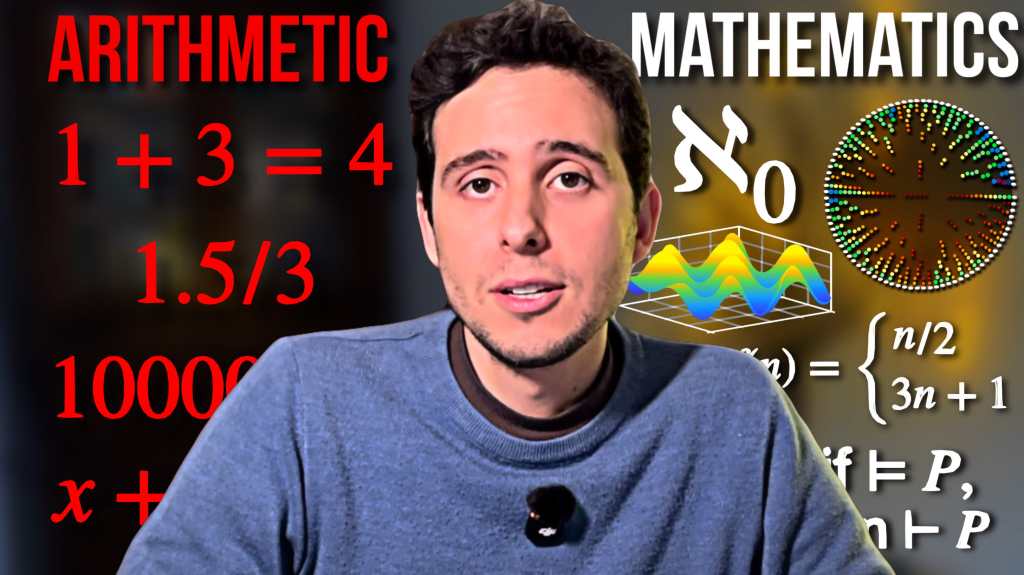
When you’re asked to consider a non-orientable hyper-dodeca-almost-icosa-oids in the 16 dimensional space with a metric nobody remembers defining, well, you’ll be in the world of pure mathematics.
But when someone suddenly asks you to add 57 to 89, and then divide that by 7.5 in your head, you’ll probably panic for a second. And then the famous question follows: “aren’t you a mathematician or something?”
What I’ve just said is a variation of a famous math meme, and it’s funny because… it’s true. The majority of the world’s population confuses mathematics with arithmetics, but that confusion is not really the problem.
The deeper issue is that people are mistaking one kind of thinking for another.
But before we get into the difference in thinking, we have to understand why basic arithmetic feels so boring sometimes.
In a typical arithmetic task, you’re given a finite list of numbers, a finite list of allowed operations, and a question whose form already guarantees an answer.
Once you begin, there are no definitions to refine, or mathematical objects to reinterpret, there’s only execution of the given task, using your predetermined set of tools (which are the arithmetic rules), and that’s just… boring.
You can’t explore any possibilities, you just have to complete the procedure, and when you’re done, the problem is finished. And that is not where the real mathematical thinking happens.
Arithmetic now is something that computers do, because it’s a mechanical task that in a certain sense is pretty monotone, and it doesn’t require much of other qualities that mathematics requires, like creativity and abstract thinking.
There are some really interesting problems that do come from arithmetic though, so the consequences are beyond adding and subtracting in complicated ways. It has deep connections to number theory, which was actually originally called “higher arithmetic”. But before we discuss them, let’s ask ourselves: where do we meet the limits of arithmetic and the beginning of true mathematical thinking? When the question stops being “what is the answer to the computation?” but becomes “what does this computation even mean?”
Unlike basic arithmetics, where all the meaning is fixed in advance, mathematics constantly asks “what counts as a valid operation?”, “what objects am I dealing with?”, and “just dealing with numbers” has been long gone at this point. Of course the examples can be long and sophisticated, but it comes down to even simple questions like “what is the shortest path between two points?”
Mathematics asks foundational questions, like:
What metric are we using?
Should the line care about direction? So is going from A to B the same as going from B to A?
Is the space continuous, discrete, or something hybrid?
And on and on we can go
Different answers to those questions lead to fundamentally different results, which is what we mean when we say that mathematics requires a great deal of creative and abstract thinking, because the questions pure mathematics deals with are a lot more complicated, but also a lot more interesting.
So, calculating things in your mind quickly is an ability, and not one that we really need because computers are faster than ever. But abstract and creative thinking is something that can’t be automated away, because it’s the part of mathematics where the rules themselves are still up for negotiation. The symbols we choose to represent objects and operations in arithmetic are just representations of a much deeper philosophy and logic that mathematics is.
Okay but, one question stands: what’s the difference between arithmetic and number theory? Aren’t they technically the same thing? Well, kind of.
Both of them often use the same objects, but they ask fundamentally different kinds of questions. Basic arithmetic takes numbers as fixed and asks you to compute them, the rules are unquestioned and the goal is just execution. But number theory takes numbers (and other concepts) and asks why these rules behave the way they do. The moment you start asking that, you will already have left the realm of arithmetic behind, even though you may still be dealing with integers, for example.
This distinction becomes really clear when you look at unsolved problems in number theory. Problems like the Goldbach conjecture or the Collatz conjecture are stated in terms which are purely arithmetic, involving only integers and elementary operations. They can really be explained to a kid. And yet, decades or centuries later, we still have no idea what the answers are. Not because it’s hard to perform the calculations, but because no amount of computation will be able to explain why the patterns are the way they are.
Maybe, more pure mathematical thinking should be taught in schools so that people become more familiar with it. I don’t mean, like, extensive proof writing, but it can be something simple, like Euler’s Konigsberg bridge problem, for example.


 DiBeos
Leave a reply to cbryant1000 Cancel reply